
Food Australia 46 (8), August 1994, pages 372–375
An oil treatment program which involved daily freshening and addition of a powder containing water, citric acid and porous rhyolite carrier was tested using fryers in a large catering operation. Effects of the program on build-up of total polar contaminants, alkaline contaminants and free acids in the frying fats were monitored. The treatment protected the cooking properties of the oil and reduced oil soakage into fried foods.
Deep fat frying is commonly used for commercial preparation of food products. The aim of the fry cook is to produce a golden crisp product with minimal oil soakage. The fry cook must therefore maintain the oil in optimum condition for as long as possible to ensure consistency in the quality of the cooked product.
In deep fat frying a complex series of changes and reactions, such as oxidation, dehydration, hydrolysis and vaporisation, produce numerous decomposition products. As these reactions proceed the functional, sensory and nutritional quality of frying fat changes and, because food quality also deteriorates, the oil must eventually be discarded.
Oil decomposition products remain liquid and cannot be filtered out of the oil. Among these decomposition products are polar contaminant materials (PCM), which include alkaline contaminant materials (ACM) and free fatty acids (FFA).
ACM are particularly reactive and are important indicators of oil quality, influencing frying rate and oil absorption by the food. ACM have three major effects:
- With pure oil, the thermal conductivity at the surface of the food (boundary oil layer) is optimal and heat moves efficiently to the centre of the food, with minimal conversion of surface food fluids to steam. The presence of ACM results in heat energy being used to convert surface fluid to steam and there is less energy available to cook the centre of the food. Cooking is slower and often incomplete, resulting for example, in chicken with a dark, overcooked surface but red on the bone.
- The changed environment at the surface of the food allows more steam to escape from the food and greater oil soakage into the food. This results in a dehydrated greasy product.
- ACM increase the foaming properties of the oil, which speeds up deterioration of the oil quality.
Because high levels of ACM result in poor quality food and excessive fat usage, the fry cook needs to keep ACM levels in frying fat at a low level.
PCM include small molecules, such as epoxides, alcohols, aldehydes and ketones, as well as polymeric materials. These materials are deposited on the surfaces of the fryer and on the foods being fried. The PCM fraction is believed to include most of the suspected toxic substances (eg acrolein) produced by fat decomposition (Alexander 1978). Rats fed the polar portion of used frying oil developed impaired liver function (Billek 1979). A high level of PCM in the frying fat is the best indicator for discarding the fat (Fritsch 1981). However, a small amount of PCM in the frying fat is needed to achieve proper golden brown colour of the food. The fry cook needs to keep some PCM in the frying fat without allowing the PCM to build-up to critical levels.
Both oxidation and hydrolysis of frying fat produce FFA. FFA generated by hydrolysis have no adverse effect on the nutritional quality of food. Generally any adverse effects will be due to FFA produced by oxidation. However, the determination of FFA by titration (the method used in this study) cannot distinguish between the FFA and therefore build-up of FFA is a poor measure of frying fat deterioration (Fritsch 1981).
The present study field-tested the Miroil FryRite program, which involves daily freshening and addition of a composite powder (Miroil Frypowder), containing water, citric acid and porous rhyolite carrier. The effect of the Miroil FryRite program on the build-up of ACM, PCM and FFA in frying fats was monitored using fryers in a large (up to 340 kg fried food per day) catering operation based at the Queensland University of Technology.
Materials and methods
The Miroil Frypowder and colorimetric test kit for estimation of PCM were supplied by Miroil, Allentown, PA, USA. Acetone (spectroscopic grade), sodium oleate, bromophenol blue and phenolphthalein indicator solutions were purchased from Sigma Chemical Company, USA. Volucon standard solution of potassium hydroxide was from Prolabo, France. Disposable polypropylene pipettes and screw-capped graduated centrifuge tubes were purchased from Sarstedt GMBH, Germany. Distilled water was further deionised (Micromeg cartridge, Elgastat, England) and neutralised by boiling and cooling under nitrogen gas.
Kitchens
To conduct the trial under live operational conditions permission was obtained from the catering manager of Spotless Catering Operations to access the kitchen facilities on each of the three campuses of the Queensland University of Technology.
Although staffed and operated according to Spotless Catering procedures, there were many differences between the three kitchens.
Size
Gardens Point (GP) was the largest facility and Carseldine (C) the smallest. Daily fried production over the 10-day testing period was: GP 338 kg; Kelvin Grove (KG) 93.5 kg; C 107.5 kg.
Fryers
GP has three Frymaster fryers of 25 kg capacity; KG has three Waldorf fryers of 20 kg capacity and C has two Waldorf fryers of 30 kg capacity.
Age
GP is a new facility with excellent layout and modern cooking equipment, including computerised fryers. The other two facilities have older, non-computerised equipment.
Menu diversity
Although the menus are generally controlled by Spotless, each facility is given some flexibility.
The manager of each kitchen was most cooperative as were the fry cooks. Each of the fry cooks is a trained, experienced chef and highly competent. These chefs however are skilled tradespersons and not scientists accustomed to the discipline required in scientific work.
Oil treatment and sampling
The Miroil FryRite procedure requires the use of Miroil Frypowder and daily filtering and freshening. At the start of each day the oil was ‘freshened’ by removal of a portion (7-8%) and then the fryer was topped up to full volume with fresh oil. This was the only time during the day that the fryer was topped up. For the continuous treatment with Miroil Frypowder, the powder was added after filtration, and for the intermittent treatment the powder was added 20 min prior to filtration. Each of the kitchens filtered their oil daily and used the freshening procedure alone (C), or the freshening procedure with continuous use of the powder (GP), or the freshening procedure with intermittent use of the powder (KG). One fryer in each kitchen was used as a control. In C this was a ‘no freshening’ procedure only.
At the beginning of the 10-day trial the fryers were boiled-out and fresh shortening (Kraft Vegetable Shortening) was added. Fry cooks were instructed on the correct use of Miroil Frypowder and asked to record oil and food usage in a log book. They were also requested to make equal use of each of the fryers in their kitchen. Although daily oil usage was recorded, the fry cooks did not keep a consistent record of food usage. Hence daily food production was estimated from the total food usage for the 10-day period. Rather than cooking for preset times, a colour scale (Van Den Bergh Foods Co, USA) was used to judge when the food was ready for serving. The oil temperature in each fryer was monitored and maintained at an optimal temperature of 170°C.
Samples of oil were collected throughout the day in a stainless steel graduated jug and small samples were stored in polypropylene screw-capped (15 mL) centrifuge tubes at 4°C until analysis (5 weeks). Labelled samples were returned to the laboratory where they were relabelled and recorded. The analyst was ‘blind’ to samples analysed. To optimise quality control, assays for ACM, PCM and acid value were performed after the collection period using a single batch of each reagent.
Acid value
Acid value was determined by AOCS Method Cd 3a-63. Oil samples dissolved in neutralised ethyl ether: 95% ethanol (1:5, v:v) were titrated with 0.01 N KOH and the acid value calculated as mg KOH to neutralise 1 g of oil.
ACM content
The quick test method of Blumenthal & others (1985) was modified for determination of ACM content in oil samples. A stock solution of sodium oleate (10 mg/mL) in ethanol: pentane (1:5, v/v) was added to pure corn oil (10 mL) to make ACM standards of concentrations (ppm): 5, 10, 15, 30, 40, 45, 50, 60, 75, 100, 125. ACM indicator reagent (3 mL) was added to 2 mL of hot oil, then after thorough mixing and centrifugation the test sample was compared visually with the standard oil samples.
PCM content
PCM content was determined by a commercial test kit (Libra Laboratories, USA, supplied by Miroil) designed by Blumenthal and Stockler. Approximate concentration (scale 1-4, arbitrary units) was determined by visual comparison with a colour chart. A score greater than 3 indicates a critical level of PCM in the oil.
Data analysis
All statistical analysis was by analysis of variance using SAS software.
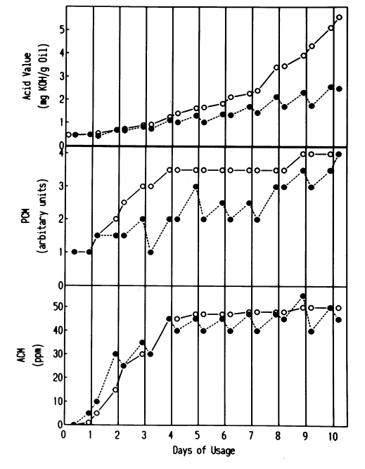
Figure 1: Analysis of oil samples from Carseldine: 2 fryers, each with 33 kg oil; total av. food production 107.5 kg/d; kg; without daily freshening (○), with daily freshening (●); (no oil top-up).
Results
Acid value (FFA)
For the Carseldine site there were no replicates and thus the effect of oil freshening on the rate of increase in the acid value could not be determined. However, there are indications that oil freshening does decrease the rate of accumulation of acid (Figure 1A).
There was no significant effect of Miroil Frypowder treatment (intermittent or continuous) on the acid value, even after correcting for oil usage, in the fryers at KG and GP (Figures 2A, 3A). These figures indicate that the highest acid values were obtained in oil collected from the middle fryer units. Our observations suggest that this might be due to the fry cooks favouring the usage of the middle fryer units.
PCM
Because a level <3 units of PCM is an industry standard, the number of days for each fryer that the PCM value was below 3 was recorded (Table 1). Although there were insufficient replicates for statistical analysis, there were indications of the following effects:
- Freshening increased the useable time of the oil (Figure 1B).
- Intermittent application of Miroil Frypowder had no overall effect on the lifetime of the oil (Figure 2B).
- Continuous application of Miroil Frypowder increased the lifetime of the oil above that obtained by the freshening procedure alone (Figure 3B).
ACM
After day 3 at the Carseldine site, the levels of ACM in the evening were significantly greater than the morning levels in the fryer containing freshened oil (p = 0.003, Figure 1C). Before day 3 there was also a significant interaction between the freshening treatment and the ACM levels at the beginning of the day (p = 0.01).
In each of the fryers at the Kelvin Grove site, ACM accumulation by the end of the day was significant when compared with the morning values (control p = .0.02, treated p <0.001). The addition of Miroil Frypowder to the oil each morning (intermittent application) significantly reduced ACM levels (p <0.001) during the morning but by the evening ACM built up to levels which were not significantly different between treated and control fryers (Figure 2C). These effects were independent of the oil usage of the fryers.
The continuous application of Miroil Frypowder to fryers at Gardens Point site significantly decreased the rate of accumulation of ACM from the evening sample of day 1 (Figure 3C). This effect was independent of oil usage of the fryers. In contrast to intermittent Frypowder application, continuous application of Frypowder maintained levels of ACM significantly unchanged over the cooking day.
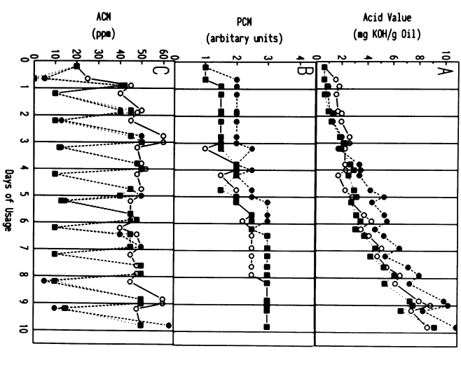
Figure 2: Analysis of oil samples from Kelvin Grove: 3 fryers, each with 20 kg oil; total av. food production was 93.5 kg/d; daily freshening (○), daily freshening with intermittent Frypowder (●, ■).
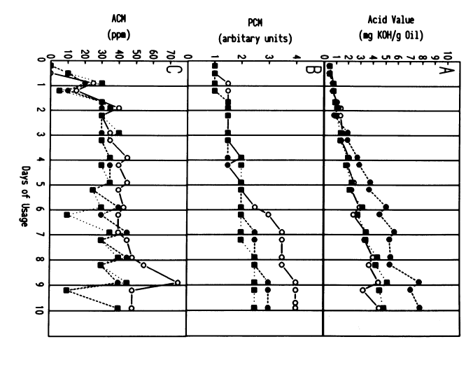
Figure 3: Analysis of oil samples from Gardens Point: 3 fryers, each 25 kg of oil; total av. food production 338 kg/d; daily freshening (○), daily freshening with continuous Frypowder (●, ■).
Oil usage
Ratios of food fried to oil used were calculated from the total (10 days) for each kitchen because records of food production for each fryer were not available. The oil used includes the volume removed for daily freshening (1.5 L per fryer) and the extra ‘top-up’ required. To estimate oil soakage the extra oil required for ‘top-up’ was divided by the quantity of food fried. Continuous usage of Miroil Frypowder (10.5 mL/kg) was found to be more economical than intermittent (26.7 mL/kg) usage. Unfortunately oil usage in the kitchens using the powder could not be compared with the third kitchen, which was not using Frypowder, because it is not usual practice in this kitchen to ‘top-up’ the fryers. Average daily oil usage is shown in Table 1.
Table 1. Oil usage and quality (PCM <3)
| Kitchen | Treatment | Oil usage (L/d) | Retention of good quality (d) |
| C | Nil | – | 3.0 |
| C | Freshening | – | 8.0 |
| KG | Freshening | 2.13 ± 0.52 | 8.2 |
| KG | ᵃFresh/inter. Frypowder | 0.12 ± 0.62 | 6.5 |
| KG | Fresh/inter. Frypowder | 1.00 ± 0.96 | 5.2 |
| GP | Freshening | 3.11 ± 1.22 | 6.2 |
| GP | ᵃFresh/cont. Frypowder | 2.11 ± 1.02 | >10.0 |
| GP | Fresh/cont. Frypowder | 2.47 ± 0.75 | 9.0 |
Observations by fry cooks
Positive comments were made by the fry cooks on the improved appearance of the cooked product, decreased cooking times and decreased oil usage under the Miroil FryRite program. There were noticeably more bubbles and steam coming from untreated oils by the second week of the trial. Negative comments concerned the extra time required for daily oil filtering and recording of food production and oil usage.
Conclusions
This trial found that the use of Miroil Frypowder improves oil usage and quality and that continuous use of the powder throughout the cooking day is the best procedure. Furthermore the results highlight the importance of the daily freshening procedure, particularly for suppression of critical levels of PCM and high acid values.
The lower usage of oil, particularly when Miroil Frypowder was applied continuously, indicates less oil absorption and greater frying efficiency. This finding is further supported by the comments made by the fry cooks.
The most dramatic effect of the Miroil Frypowder was on the suppression of alkaline contaminants. The freshening procedure had little effect on the build-up of these materials in the frying oil.
Acknowledgement
We would like to thank Mr Dennis Morgan, Managing Director of Miroil (Aust) and Mr Ken Morgan, Catering Manager of Spotless Catering Operations (Qld) for supporting this study and Ms Ha Le for technical assistance.
References
- Alexander, J. 1978. Biological effects due to changes of fats during heating. J. Am. Oil Chem. Soc. 55: 711.
- Billek, G. 1979. Heated oils – chemistry and nutritional aspects. Nutrition Metabolism 24 (supp 1): 200-10.
- Fritsch, C. 1981. Measurement of frying fat deterioration. J. Am. Oil Chem. Soc. 58: 272-5.
- Blumenthal, M, Stockler, J & Summers, P. 1985. Alkaline contaminant materials in used frying oils: A new quick test. J. Am. Oil Chem. Soc. 62: 1373-4.
- Blumenthal, M & Stockler, J. Polar contaminant material (PCM) in used frying oils: a quick test. Libra Laboratories, USA.
Author information
Dr Christine Booth is a Senior Research Officer, Margaret Wingett is a Lecturer and Steven Koch is a final-year Chemistry student at the Centre for Public Health Research, Queensland University of Technology, Kelvin Grove Campus, Locked Bag No 2, Red Hill Qld 4059.