
U.S. patent #5,200,224
MIROIL has solved the mystery surrounding the seemingly simple process of frying. Unprecedented benefits have become a reality for Frypowder users. This new frying technology is like Alice in Wonderland to most frying professionals. One concept that is revealed is the futility of the search for . . .
Longer life of frying oil
Products that promise longer oil life rarely provide meaningful cost benefits. The savings derived from less discard of oil are always offset by more oil absorbed by the food during the period of extra oil life. More important is the fact that the food is not as good as it could be, and much less “healthy” than it should be.
How many days you use the oil, is not of great importance. What really counts is how good is the food? and how much oil do you actually use?
With Frypowder, less oil is discarded and much less oil is absorbed by the food. Frypowder users receive real savings and enjoy many other unexpected benefits.
Frypowder is different from other products that promise longer life of oil because of the patented way it protects the performance of frying oils. The fry cook is able to use less oil to produce great food, always.
Frypowder functions uniquely to capture (by adsorption) reactive breakdown substances as they form in the oil, This prevents many subsequent reactions which would otherwise be responsible for a multitude of other polar (oil breakdown) substances being present in the oil.
Frypowder and the FryRite™ Frying Program is the only way to prevent deposits of carbon and polymer gums on fryer surfaces and to avoid the need for fryer boil outs with caustic in order to operate clean fryers with efficient heating surfaces.
The new frying technology is the opposite of what is expected. Foods cook faster at temperatures of 170°C (or less) than they do at 180°C (and higher). The foods cooked at lower temperatures have a light golden brown finish, and contain less absorbed oil.
Cooking at temperatures of 180°C (and higher) are counterproductive because oil degradation reactions are accelerated, and the levels of polar substances are increased. There are serious health concerns related to higher frying temperatures. Six countries have established 180°C as the maximum temperature acceptable for foodservice frying1.
The popular practice of operating foodservice fryers at temperatures of 180°C (and higher) is used to ameliorate adverse symptoms from degradation of an oil’s cooking performance. These “symptoms” are food with more absorbed oil, darker, overcooked surfaces, and undercooked centers.
These “symptoms” which are attributed to lower frying temperatures are actually caused by a “High Temperature Effect” (HTE) from the presence of ACM surfactants in the oil. HTE causes the oil to deliver its heat to the surface of the food with greater intensity (with the same effect that would occur if the oil temperature was 20°C or 30°C higher).
See the data summarized below to understand why lower temperature can cook food faster with less, rather than more, oil absorption.
| Day 4 of 4 day cycle | Day 7 of 8 day cycle | |||
| w/o Frypowder | w Frypowder | w/o Frypowder | w Frypowder | |
| TOTAL HOURS | 39.5 hrs | 39.7 hrs | 73.0 hrs | 73.3 hrs |
| ALL FRIED FOOD | 56.8 kg | 93.5 kg | 110.7 kg | 191.2 kg |
| FOOD-OIL ABSORPTION | 3.0 kg | 2.9 kg | 10.4 kg | 10.2 kg |
| POLAR SUBSTANCES | 19.1% | 16.1% | 25.3% | 18.4% |
Data abstracted from an evaluation of Frypowder product performed under direction of Dr. Gertz, Chemiedirecktor of the Stadt Hagen Health Authority
Same oil, same food, same cooking time.
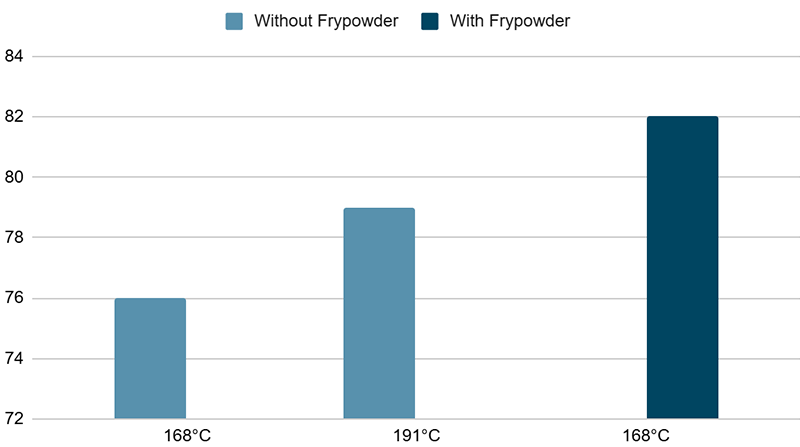
The dramatic effect of “before and after” abatement of HTE as demonstrated by Dr. A. Philip Handel at the Dept. of Nutrition and Food Sciences, Drexel University.
1. Firestone, D., Worldwide regulation of frying fats and oils, Vol. 4. no. 12 (December 1993)
Reprinted from INFORM, the journal of American Oil Chemists’ Society, Vol. 5, no. 4 (April 1994)